September 30, 2012

In Case You Missed It...Psychtember Week 4! (And an Extension...)

psychtember2012button1-2

Worried that you missed a few Psychtember posts this week? Relax — they're all here!

Week 4 posts:

Guest Posts: 


Body Dysmorphic Disorder

Why Bully?

How Much Should You Emphasize Your Character's Mental Illness?
  
Reviews:

Perfect Escape: A Psychtember Review

Ultraviolet: Guest Review

Fall For Anything: Guest Review

Something Like Normal: A Psychtember Review

Wintergirls: Guest Review

Interviews:


Jennifer Brown

Miscellaneous:


Psychtember "Waiting on Wednesday" picks

Giveaways:

Jennifer Brown giveaway (Bitter End and Perfect Escape) – US only, ends 10/10

Remember, the Something Like Normal and Streamline giveaways both end today!

Also, the YA involving mental health issues (2000-present) Goodreads list has almost reached 50 books! Let's keep on expanding it :)

I know it's the last day of September, but I've still got a few more Psychtember posts planned (that's right, there's just too much Psychtember goodness to be had!) so I'll be extending the event into October. So keep on checking back!

September 29, 2012

Wintergirls: Guest Review

Najela from Brave New Adventure is back with another Psychtember post! Today she's reviewing Wintergirls by Laurie Halse Anderson.

Summary:  Lia's best friend, Cassie, died alone in a hotel room after running away and since then Cassie's been trying to make sense of the 33 phone calls she left that night. Lia is racked with guilt from her best friends death, but even then, she can't seem to bring herself out of the throws of her anorexia. She constantly wants to lose weight, deceiving her family into believing that she's healthier than she already is. She's already been to an inpatient care facility, going through the motions of being healthy and being okay. Her therapists are trying to unravel Lia's issues, her parents are blaming each other for Lia's issues. 

Likes: This was a chilling tale.  It was heart wrenching to see Lia trying to solve her own problems and the adults around her not being able to help. All of the characters were flawed and real. The adults were too busy blaming each other to be helpful. They just assume Lia's okay because she says she's okay, but they don't look into the subtle signs such as her cutting up her foods, the laxatives and diuretics hidden in her room, and the fact that they don't talk to her concerning her friends death. Lia was dealing not only with anorexia, but grief as well.  The two of these combine don't make a good mix and it seems that every thing that Lia deals with becomes too much and she goes to drastic measures to deal with her grief.

Psychological Aspect: The psychological aspect of this novel was chillingly real, especially towards the end when reality was blurred. Sometimes when you starve yourself long enough, you'll begin to start to hallucinate as your body starts to shut down. Anorexia is a psychological issue in which a person believes themselves to be overweight and goes to extreme measures to lose the weight they think they have. Cassie's friend suffers from an eating disorder known as bulimia,  in which someone binge eats, then purges (vomits) the food in order to stop themselves from gaining weight.

When I thought of this story, I didn't think the reasons why Lia and Cassie had eating disorders, but when I thought about it a little more to it than that. I'm not a psychologist, but within the confines of the story, the reasons were simple. They usually always are. Certainly there are enormous reasons why a psychological disorder would start, but sometimes there aren't. Cassie started copying all the girls she met at camp and Lia started copying her. They found that these acts soothed something inside of them. It's the same way someone becomes an alcoholic or a drug addict.

Writing Tip:  Psychological disorders typically don't happen overnight, it's a gradual process. The triggers don't always have to be a traumatic experience. For the sake of the story, it could be, but it would depend on where you start.

Another Book to Read: Hunger


Najela is a graduate from UC Riverside with a dual degree in Psychology and Creative Writing and finally making the most of both degrees. She works with kids and is currently pursuing a Master's Degree in Exceptional Student Education. She is also working on several writing projects including a Beauty and the Beast retelling webcomic coming in late October 2012. You can follow her at her website or her tumblr.
   
Thanks very much, Najela, for sharing your reaction to Wintergirls!

September 28, 2012

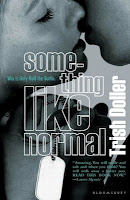
Something Like Normal: A Psychtember Review

Patient: Something Like Normal by Trish Doller

Presentation (from Goodreads): "When Travis returns home from a stint in Afghanistan, his parents are splitting up, his brother’s stolen his girlfriend and his car, and he’s haunted by nightmares of his best friend’s death. It’s not until Travis runs into Harper, a girl he’s had a rocky relationship with since middle school, that life actually starts looking up. And as he and Harper see more of each other, he begins to pick his way through the minefield of family problems and post-traumatic stress to the possibility of a life that might resemble normal again. Travis’s dry sense of humor, and incredible sense of honor, make him an irresistible and eminently lovable hero."
Assessment:

Axis 1. Characters

The characterization in Something Like Normal is wonderful. Travis has one of the most authentic and yet still appealing guy voices I've read in quite a while — and this is coming from someone who doesn't typically like 1st-person teen guy POVs. It's difficult for me to find books with a male teen narrator where I'm interested in what they're saying and can connect to them on some level, and I feel like Trish Doller really accomplished that with Travis. He's a flawed character, to be sure; his behaviour's less than ethical at times, he shows spurts of temper, and though he recognizes he has some psychological issues, he's not quite ready yet to take the step of admitting he needs help. And yet despite these flaws, there's something very attractive about him. I like his honesty, and the way he doesn't take flack from people. 


I feel like he wants to be a better person, and he realizes that he's a better person when he's around Harper, so he wants to be with her. It's neat that we get to be inside Travis' head and see him starting to fall for Harper and care about someone in a way he hasn't before. As for Harper, I appreciated that she stood up for herself and didn't let him walk over her. I think they're good for each other — Travis is pretty bitter and jaded at the beginning, and as Harper softens him up he starts to become more hopeful. She seems like a steady girl who will keep him grounded. Paige provides a nice foil for Harper, since Travis feels very differently about each of them.


Travis' dad is a very generic, "All American" sports dude. He doesn't ever really venture out of cliche, but he's obviously intended to be disliked — and he certainly succeeds at serving that purpose. Basically, he's one of those really irritating dads who want to live vicariously through their kid, and want to see their kid do well so they can be hotshots. He reminded me a lot of the jock's dad in The Breakfast Club, who's pressuring his son all the time. In short, he's a jerk.

In contrast, Travis' mom actually cares about her son, and it's really sweet to see that. I like that he's standing up for his mom, and that they're getting to know each other better after so many years of her sitting on the sidelines while his dad railed at him. 

It's clear that Travis had a strong connection with Charlie (a fellow Marine and friend who was killed) and that their friendship was very important to him. We don't see that kind of emotional bond very often with male characters (at least, not in YA), so it was refreshing to see that level of connection here.


Axis 2. Premise/plot


There isn't much action happening here, but it's quite short and surprisingly readable — I breezed through it in just a couple of days. It could have been a little more dramatic in places (for instance, the PTSD could have been amped up) and I wish a few of the storylines had been more fleshed out. I never felt like we had a good grip on Travis' relationship with his brother Ryan, so I would have liked to have seen more of that (Ryan just seems to get dropped out of the story after a certain scene). More information about the political side of things in Afghanistan would also have been interesting, although obviously that isn't the point of this book. Rather, it's all about Travis' recovery and his emotional healing process, and that is done really well.

In terms of the ending, things wrapped up awfully fast, with a lot being resolved within just the last few chapters, and I think it could have been stretched out a bit more. It seemed too neat and easy a conclusion, with a couple of "heart-to-heart" conversations that dipped into cheesy/sappy. The closing letter was a nice touch, though. While the ending is hopeful, it left me feeling sad in some ways, too. Overall, it's a kind of bittersweet book, not entirely uplifting — Charlie's dead at the beginning and so obviously he's still dead at the end. I was glad that Travis winds up in a better place emotionally, though.

Axis 3. Writing Style

Trish Doller's ear for the male teen voice is impressive. A lot of female authors writing YA novels with male perspectives don't succeed at this aspect, but the way Travis talks and thinks seems quite "guy-like". Most of the dialogue is authentic, and Doller does not shy away from coarse language/references and distasteful jokes in some situations (for example, when Travis is hanging out with his Marine pals). While crude conversation isn't something I really enjoy, I can appreciate that it feels real.
 
Axis 4. Psychological Accuracy

Travis' main psychological problem is quite obvious: post-traumatic stress disorder (PTSD). He displays some of the classic symptoms, such as nightmares/difficulty sleeping, startling easily (gunshots set him off), flashbacks, and a dislike of talking about his time spent in Afghanistan. These symptoms fit quite neatly with the DSM-IV criteria. 


In addition to these, he exhibits signs of psychosis in the form of hallucinations — usually of Charlie. Apparently it's not unusual to experience psychotic symptoms along with PTSD, so this is also in line with research on trauma. 

It's interesting that we're shown a little of how another soldier has reacted differently. Kevlar turns to alcohol and thrill-seeking; he wants an adrenaline rush all the time, the kind that he got in Afghanistan and doesn't get anymore. Adrenaline seems to act similarly to an addictive substance for some individuals. I suspect these are also signs of PTSD — indeed, the upcoming DSM-V has added "reckless or self-destructive behavior" to the list. 

I would have liked to have seen the stigma of mental health issues, especially in the military, discussed a little more. It's touched on slightly (in particular, Travis states, "The evaluation is also supposed to gauge our mental wellness, but that's a joke. We say everything is okay because the fastest way to wreck your career is to admit it's not.") but not addressed in detail. I also wish we'd gotten a glimpse of Travis' therapy, but it's just mentioned at the very end in passing.
 
Validity Score: How psychologically accurate was Something Like Normal?


Axis 5. Miscellaneous

I liked that it's not too preachy, and that the author isn't taking a strong political stand here. As I mentioned earlier, politics don't play a big role, but when they do surface they aren't handled in a black-and-white kind of way. 

A couple of the blurbs on the back of the book use the word "unflinching," which makes it sound like it could be gritty and violent. It's emotionally tough and depressing, definitely, and feels like this is something that someone who's come back from Afghanistan would experience, but there's nothing really graphic in here at all. In fact, I think the "grit" factor could even have been raised a bit more (although I wouldn't want it to degenerate into gratuitous violence).
 
Patient shares symptoms with: BADD by Tim Tharp, The Things a Brother Knows by Dana Reinhardt, Purple Heart by Patricia McCormick


Patient's statement:


I lift my beer cup for a drink. Dirt fills the lines of my hand, and my fingers are stained with blood. The cup slips from my grasp, splashing beer across the top of the table. Paige jumps off Ryan's lap, shrieking something at me, but I don't understand what she's saying. My chest is tight and I'm having trouble breathing.


I have to get out of here.
 
Diagnosis: 4 shooting stars. This is definitely a good book to check out if you're interested in PTSD or soldiers' reactions to war, or if you're looking for a distinctive and sympathetic male teen narrator. It doesn't bring anything really novel to the subjects of war and trauma, but it excels in characterization and relationships.


This book counts towards my goals for the Debut Author challenge, the Just Contemporary challenge and the New Adult reading challenge.


Note: This book contains some coarse language/references and sexual content. 

Also, I interviewed Trish Doller earlier this month! 

For more information about PTSD, see here.

Guest Post: How Much Should You Emphasize Your Character's Mental Illness?

I'm pleased to welcome Dr. Carolyn Kaufman, author of The Writer's Guide to Psychology, back to the blog! I interviewed her last year for Psychtember (you can read Part 1 here and Part 2 here) and this time she's participating with a guest post in response to a question I sent her. Take it away, Carolyn!


One thing I've noticed with many YA books is that when a character has a mental illness, the whole story becomes focused around that aspect and it turns into an "issue book." Do you think this is helpful, or would it be beneficial to have more stories that feature teens that just happen to have mental illnesses? Why?

I think “issue books” often do a nice job of showing what it’s like to deal with a psychological problem, which benefits teens who are dealing with a mental health issue in their own lives, or in the life of a friend or family member. As our ability to recognize and talk about psychological issues has expanded (and as diagnostic criteria have expanded), we’ve become more aware of psychological problems that used to get misdiagnosed or swept under the proverbial carpet. Even people who have not been directly impacted by a psychological disorder can benefit, because we all are bombarded with TV shows, movies, and even cartoons that make assumptions (many of them wrong) about what someone with such a disorder is like. Getting an insider’s point of view makes us more empathetic.

I do like stories that address psychological problems without making said problems the axis on which the story turns, however. Though many people with undiagnosed or newly diagnosed problems are consumed by the disorder that’s bogging them down, many, many people learn to manage their diagnoses. The diagnosis then becomes an ongoing part of their lives, but not by any means the thing that defines them.

In other words, when someone is first diagnosed with something like ADHD or bipolar disorder (manic depression) or panic attacks, they may go through a stage of using the diagnosis as part of their identity.  For example, they may say to people, “I’m bipolar,” or “One of my prominent characteristics is my ADHD,” or “I really have to think about my panic attacks before I can do anything else.”  But just like teens with epilepsy or diabetes learn to adapt and make dealing with the problem part of their daily routine, so too do many people with psychological problems.  And I’m not sure that’s portrayed often enough in fiction—people coping with their problems.

Granted, stories are more exciting when there’s drama and conflict, but the period when someone is first diagnosed isn’t the only time that things can be shaken up! For example, someone who has learned to manage a disorder must also learn if, when, and how they are going to tell others. For example, when and how does a 17-year-old girl who’s trying to impress her new boyfriend tell him she has a problem with bipolar disorder? There’s still a great deal of stigma toward mental illness, and it is usually much harder to say “I have manic depression” than it is to say “I get migraines” or “I have diabetes.” She will probably worry about how her boyfriend is going to take it, whether he’s going to think she’s “crazy” for having to take meds and visit a psychiatrist, whether he’ll tell other people. And even if he handles it well, what if his parents disapprove? And what’s he going to do the first time he sees actual symptoms? Will he be supportive, demeaning, afraid, angry?

In addition to that, her lifestyle may not mesh with her peers’ expectations. She may not be able to stay up all night, sleep irregular hours, eat like her body is a garbage disposal, let her blood sugar drop too low, use popular remedies (like appetite suppressants, high-caffeine drinks, or over-the-counter-cold medicine), or drink alcohol. (Yes, 17 is under the legal drinking age, but we know that many teens experiment before that.) Things like this can trigger bipolar episodes or exacerbate symptoms.

Also remember that stressors can aggravate many psychological conditions, so even a character who normally deals well can be thrown off track by a breakup, changing schools, or a parental divorce.

Finally, I think a lot of authors do extensive research to try to understand a disorder they want to portray, and we all know how tempting it is to use everything we’ve learned! But sometimes a light touch is best.  You can, like I said above, remind yourself that the disorder is a part of the person’s life, something that needs to be managed, not something that defines him or her.

I have a character who has panic attacks in social situations that involve pressure. This isn’t a huge part of the novel, and I never even name the problem (i.e. panic attacks). Instead, I just show him doing his best to deal with each attack as it comes. In a good novel, a vulnerability like this really should flare up and cause problems at a crucial moment, but again, it doesn’t need to define the character or the novel.


Carolyn Kaufman, PsyD's book, THE WRITER'S GUIDE TO PSYCHOLOGY: How to Write Accurately About Psychological Disorders, Clinical Treatment, and Human Behavior helps writers avoid common misconceptions and inaccuracies and "get the psych right" in their stories. You can learn more about The Writer's Guide to Psychology, check out Dr. K's blog on Psychology Today, or follow her on Facebook!


Thanks very much, Carolyn, for this insightful look at how to write a character with mental illness without turning the story into an "issue book"!

Readers — do you like it when a book zeroes in on a particular mental health issue, or do you prefer to see stories where it's there, but not the main focal point? Can you recommend some YA books that aren't "issue books" but still accurately portray a character with a mental illness?

September 27, 2012

Psychtember Interview with Jennifer Brown (and Giveaway!)

Jennifer Brown, author of Hate List, Bitter End, and Perfect Escape, is dropping by the blog today with an interview for Psychtember! I reviewed Bitter End for Psychtember last year and Perfect Escape this time around.

Here's a little more info about Jennifer and her most recent YA novel Perfect Escape:

"I've pretty much always been a dreamer, lining up my dolls and stuffed animals on the stairs and "teaching" them things. I had imaginary friends (which was good because we moved pretty often and I pretty regularly found myself with few real ones) and would hold "conversations" with them. I didn't realize it at the time, but I was telling them stories, and it was my favorite pastime.

I never wanted to be a writer (I was going to be a teacher), even though I was always writing. My first story was a short story, written in 4th grade. It was two pages long, hand-written, and my characters had names like Donna Schlieigermeigssterkks. I showed it to my grandma, who loved it so much she called my aunt on the phone and read it to her.
Even though Grandma was cracking up while reading it, I was hooked by the celebrity of it all. Since then, I've always written, even when I thought nobody would ever read any of it.

Writing didn't turn into a dream until about 10 years ago when my husband, Scott assured me people wouldn't laugh at me. Turns out, he was wrong. People laugh at my writing all the time. It's just... well... I'm a humor-writer... laughing is what I want them to do. It also turns out he was right. Sometimes I can write serious stuff, too.
"
(from her website)


"Kendra has always felt overshadowed by her older brother, Grayson, whose OCD forces him to live a life of carefully coordinated routines. The only way Kendra can stand out next to Grayson is to be perfect, and she has perfection down to an art -- until a cheating scandal threatens her flawless reputation.

Behind the wheel of her car, with Grayson asleep beside her, Kendra decides to drive away from it all -- with enough distance, maybe she'll be able to figure everything out. But eventually, Kendra must stop running and come to terms with herself, her brother, and her past.

With undeniable grace and humor, acclaimed author Jennifer Brown explores OCD, the pressure for perfection, and the emotional highs and lows of a complex sibling relationship." (from Goodreads)

Now for the questions...

1.) Perfect Escape, Bitter End, and Hate List are all contemporary YA books tackling issues related to mental health and psychology. What motivates you to write stories involving these kinds of emotionally hard-hitting topics? Do you think you'll continue to write in this vein, or do you ever see yourself switching gears entirely to another style or genre?

The things I write about are things that real teens are encountering every day. I think it's important to talk about tough issues and how we can overcome them. Knowledge truly is power, and the first step to making change, and I like writing books that can help get a discussion going. Also, my wish is that my books, tough as the subjects are, will provide some hope to young adults who are experiencing the things my characters are going through.

I do think I'll continue to write these kinds of stories, always, but I love to try out new things. New styles, new genres, new audiences all interest me, so I definitely hope to write some stories in different genres as well.

2.) You clearly do your research when it comes to the psychology of your characters' behaviour. Do you find it a challenge to balance communicating facts/knowledge about a disorder or issue with making your characters and their interactions believable? If so, how do you approach this hurdle?


I actually think really understanding a social issue or the psychology of my characters helps me make them more believable. In general, what works for me best is understanding everything I can about what makes my characters tick. When I have troubles, it's because I don't know them well enough. The hurdle can sometimes be making sure the story isn't too "textbook." What is most dramatic isn't always what's most realistic. It's a fine line to walk.

3.) The term "OCD" appears a lot these days in pop culture and the media, but it's not always used correctly, resulting in misinformation about the disorder in the general public. If you could ensure that readers remembered one fact about OCD from Perfect Escape, what would it be?


I think a lot of people confuse perfectionism with OCD. You hear people say, "I've got a touch of OCD" when they really mean that they're perfectionistic about something -- they like their things kept just-so, or their house super clean, or they don't like to touch door handles of public restrooms and so forth. But OCD can be a debilitating anxiety disorder that can really interrupt someone's life. Some people who have OCD are, in many ways, held hostage by it. They might spend hours each day washing their hands or brushing their teeth, they might not be able to leave their houses or will spend so long with their rituals before leaving their houses that they're chronically late and will lose jobs and relationships or so forth.

I also think it's really important to remember that a person who suffers from a mental illness is not only that mental illness. It can be so easy to get frustrated or frightened or just want to condemn a person for their struggles, but as Grayson showed in Perfect Escape, there are lots of complexities and emotions that come with mental illness, not the least of which is the desire to be out from under it.

Also, it's important to me that people understand what it's like growing up alongside someone with mental illness. Sometimes it can be easy to ignore the "well child," in favor of the one who needs more attention. Like Kendra, sometimes siblings of someone who struggles just want to be heard, be validated.

4.) It's unusual these days to see a YA novel without a central romance, but in Perfect Escape the focus is on the brother-sister relationship of Kendra and Grayson. Were you concerned that this might negatively affect the appeal of the book to teens? What qualities would you say Kendra's and Grayson's relationship embodies that would not be present in a romance?


Really, none of my novels have much of a romantic element. You get to see glimpses here and there of Nick's and Valerie's relationship before the shooting in Hate List, and you get to see the buildup of Alex's and Cole's relationship in Bitter End, but neither of those novels really have any sort of central romance to them.

Honestly, I'm not even thinking "romantic relationship" when I sit down to write a novel. There are many relationships outside of romantic ones that are interesting and important to teens. I get a lot of reader comments about the relationship between Valerie and her younger brother, Frankie, in Hate List, so I know that teens do care about sibling relationships. I know that romantic relationships are important to teens, but so are best friend relationships, parent relationships, extended family relationships, work relationships, and sibling relationships, so I wasn't worried about teens being able to relate.

I think one thing that Kendra's and Grayson's relationship embodies that romances might not is ease. They're both comfortable just being themselves and saying what they're thinking, and not worrying about "looking good" to one another. This lends itself well to humorous moments as well as touching moments, and I think it helps us to see all the nuances of the characters a little better, because nobody is putting up any sort of front.

5.) If you could match up two characters from any of your three published YA novels — either romantically or just as friends — who would you pair, and why?


I would try to match up Grayson with the Alex, Zach, Bethany friend trio in Bitter End. I think they would accept him for who he is, and I think he could use a few more friends.

6.) You've got two more YA books coming out in the next couple years: Thousand Words, about a teen girl caught in a "sexting" scandal, and Torn Away, about grief in the aftermath of a tornado. Can you give us a few hints about what to expect from either of these?


These are two very different novels. In Thousand Words, you can expect to see what happens when a bad breakup turns into a worst nightmare. It's a worst-case-scenario of what could happen when a naked photo goes viral and gets labeled "child porn." In Torn Away, my main character, Jersey, loses everything in a tornado, and spends the summer being shuttled around to various family members. It's a story about family, and love, and acceptance.

Thanks so much, Jennifer, for these thoughtful replies to my questions!

Jennifer has kindly offered up *signed* copies of both Bitter End and Perfect Escape for giveaway.

So, here's how this is going to work:

- There will be TWO winners. Each winner will receive one copy of Bitter End and one of Perfect Escape.

The rules:

- Entrants must be 13 years or older.
- Open to US only
- One entry per person
- Following and tweeting are not necessary but always appreciated!
- Ends Oct 10, at 11:59 pm EST.
- Winners will be selected randomly and contacted by e-mail

To enter, please fill out THIS FORM. Comments are wonderful but do not count as entries.

Related Posts with Thumbnails