September 10, 2012

Guest Post: The Stigma of Mental Health


Christina Lee from www.write-brained.com is stopping by today for a guest post on stigma. You can read her guest post from last year's Psychtember here. Welcome back, Christina!
Based on some recent YA novels I’ve read, here’s a recap of what mental health looks like: a teen reluctantly trudges to the counselor/social worker/therapist’s office. Said therapist is bumbling idiot or really quirky or just plain stupid. Or at the very least, they ask really dumb questions. The teens slumps in the chair, mumbles, crosses their arms, thereby closing the therapist off.  They refuse to fess up or be honest about their problems, which might be the symptoms to a real disorder like OCD, Bi-Polar, Anxiety, or Depression. The symptoms list could include: failing grades, no friends, anger, shouting matches with parents, breaking school and home rules, impulsivity, crying jags, or general unhappiness.  
Now let’s swap the mental health disorder for a medical problem, like diabetes, celiac disease, or epilepsy.  The above scenario looks totally ridiculous, no? No way would someone march into a doctor’s office and act that way. They’d want to help for their problem, STAT.  They wouldn’t treat the doctor like crap, even if denial, anger and sadness came later.
So, it’s 2012 and mental health still has a bad rep. It’s definitely improved, more readily accepted, and people are diagnosed and getting help every day. But it’s still hidden, shameful, not something people willingly discuss—especially when it comes to kids, therapy, and meds.  People still use words like crazy, psycho, schizo, and whack-a-doo in describing certain scenarios.
And yeah, teens are supposed to buck the system, refuse help, and hate adults. But not all teens, all the time. And maybe it’s just getting old and kind of gimmicky, but I am now seeking books that are not representative of the above scenario—I know they’re out there.  And truth be told, I’m writing one myself. Because though you never ever want to get preachy in YA, you do want to show reality and growth (also known as character arc). And growth can be shown without the teen refusing help or getting off those “crazy” meds. There are living and breathing people walking around who will probably need help and/or meds their entire lifetime, just like a diabetic would. And that, my friends, is reality.
Christina Lee has been a social worker and a special education teacher (also, a dinosaur excavator, a Lego contractor, and a Thomas the Train conductor), and finally realized that she could turn her love of words into her DREAM of writing. 
She writes freelance and Young Adult fiction and blogs at www.write-brained.com . She also own a hand-stamped jewelry business called Tags-n-Stones, which requires her to stamp lots of letter and words onto pieces of silver. Notice a pattern here?

I agree — it has gotten somewhat better, but unfortunately stigma of mental health issues is still very much present. Thanks very much, Christina, for sharing your views on this issue!

September 9, 2012

In Case You Missed It...Psychtember Week 1!

psychtember2012button1-2

If you haven't heard yet, Psychtember has begun!!

Here's the first week or so in posts:

Introductory post — I've started a Goodreads list for "YA involving mental health issues (2000-present)" and I'd love your help in adding to it! So check it out and vote for your faves.

Guest Post: Bibliotherapy and the Power of Books

Coming To Terms With Psychology Terms

Chopsticks: A Psychtember Suggestion

Guest Post: Teens, Bipolar, and a Very Different Ghost Story

Psychtember "Waiting on Wednesday" picks: Out of Reach and Trinkets

Interview with Janet Ruth Young, author of My Beautiful Failure

Tenderness: A Psychtember Review

The reviews, interviews and guest posts are going to keep on coming, as well as a few giveaways, so be sure to check back regularly!

September 8, 2012

Tenderness: A Psychtember Review

Most of my Psychtember reviews will be formatted differently than my standard reviews, to reflect the mental health theme. I've structured things as though the book is the patient and I'm giving it an assessment. Each axis is an aspect of the book that I'll give my thoughts on (characters, plot, etc.), and the validity score refers to how psychologically accurate I think the book is. Then I may list some other books that this one "shares symptoms with" (i.e. novels dealing with similar topics) and provide the patient's "statement" (quote) before giving the "diagnosis" (my shooting star rating). The rating still reflects my overall view of the book, using my standard rating system. 


Patient: Tenderness by Robert Cormier 


Presentation (from back of book): "Eric has just been released from juvenile detention. Now he's looking for some tenderness — tenderness he finds in caressing and killing innocent girls.

Lori has run away from home again. She is also looking for tenderness — tenderness that is about more than just sex, tenderness she finds in Eric. 

Together, they begin a harrowing journey that will either save or destroy them."

*Note: it's difficult to avoid spoilers entirely in this kind of review. I have white-texted the most obvious ones, but there may be some milder spoilers. You have been warned.

Assessment:

Axis 1. Characters

Eric: he's a difficult character to understand or empathize with — not surprising, given the fact he likes to assault and kill girls — but it's clear what the author is trying to show us: he's basically a psychopath with mother issues (the Freudian interpretation of his behaviour is addressed in more detail below, on Axis 4). Interestingly, Eric does feel some emotion — which goes against the traditional understanding of psychopaths, but is in line with recent research findings. He doesn't seem to feel much guilt about the girls he's murdered, but one could argue he feels culpable at another point in the story (major spoiler, highlight to read: ironically, it's about the one death that isn't his fault, Lori's, and he actually cries). I never really understood what Eric got out of murdering these girls, but we're told he experiences these "moments of tenderness" (hence the book title). 

In a strange way I preferred Eric's character to Lori's, because he's more rational, and in some situations he can be nice and considerate. He actually forms a bit of an affectionate relationship with Lori, so it feels like he's not wholly "bad." At the same time, it's obvious, of course, that he is very psychologically disturbed, and although we don't actually see the murders he's committed, he thinks about what he's done or going to do to these girls with fondness and excitement. We see different aspects of him as we go through the book, elevating him to a complex, more-than-black-and-white level and almost making him a sympathetic character in some respects. However, there's no getting around the fact that he is an unrepentant murderer, and that never goes away.

Lori: I found Lori even harder to figure out than Eric. She has these unusual "fixations" as she calls them, that are never explained properly, which involve kissing strange guys. More worrying is that she believes herself to be in love with Eric, and she continues to stay with him despite the fact that she knows he was charged with murdering his parents, and she's heard rumours that he's murdered young girls. I just had to keep asking, "WHY? Why is she behaving so idiotically? Why is she risking so much?" It actually made me kind of mad that she was so careless with her life. 

She seems to be motivated a lot by a need for attention, as she's very insecure, and she's drawn to charismatic guys (which Eric can definitely be when the situation requires it). There's also the reason given — and I thought this could have been put a good deal more subtly — that she loves him because he doesn't assault her or treat her like other guys have. Lori's attracted a lot of male attention, often unwanted, in the past, and though she is used to using her body to get what she wants, she doesn't like it. 

But she does not have a speck of sense in that head of hers, and I found her to be a very frustrating character, who I honestly didn't feel really sorry for. She seriously has no sense of self-preservation. Also, there was one thing she did in particular which I took issue with (spoiler): she encouraged Eric to hang out with a girl that fits his "type" when she knew he could be a killer. In essence, she was helping to put that other girl's life at risk!

Eric and Lori:

Honestly, the two of them together is pretty much the worst possible combination of two people: he's a psychopathic killer of young girls, and she's a young girl who always thinks or does whatever is completely counter-intuitive. The only thing that could have made it more disastrous is if she had been the physical type that Eric was drawn to. (And if she was, she would have been dead shortly after they met and there wouldn't have been much of a story!) 

Interestingly, though, Lori does have an effect on Eric. At the beginning he comes across as quite the cold psychopath, but Lori brings out different sides of him, shaking him up. He isn't as rational and careful after spending some time in her company, and at the end it almost seems like he's losing his touch. It's just possible that he isn't an entirely hopeless case, and she may have changed him a little bit. It's tempting to think that if they began some kind of romantic relationship, she could "save" him, but he needs more help than she can possibly offer.

Ultimately, the bottom line is: they both need a whole lot of professional help.

Axis 2. Premise/plot

Plot-wise, it's actually not the most exciting or unpredictable read, but it's so psychologically twisted that you want to keep reading to find out what happens, because you just know it's headed for disaster. There's a low-level tension throughout because of the whole 'creep factor.' I was a little disappointed that the finish wasn't more dramatic; it comes off somewhat anticlimactic but it does feel fitting in a way, and ripe with irony. Still, I wasn't totally satisfied by the ending — I'm not sure what I was expecting but I think I would have liked more explanation for Eric's behaviour.
  
Axis 3. Writing Style

The writing style reflects the time the book was written (it was published in 1997), so it does feel a little dated. It's quite simple, with lots of similar sentence structure, but I feel like it doesn't need to be very fancy or convoluted because there's so much creepy stuff going on; the point here is not the writing.

The switching back and forth between Eric's and Lori's perspectives worked for the most part, although it was a bit confusing and jarring when it occurred within the same chapter. The 3rd-person POV used for Eric's sections provides what I think is a necessary distance that allows us to see him as a criminal; it would be difficult to have a 1st-person POV that managed to show who Eric was without alienating the reader. Unfortunately, despite the fact Lori's sections are told with 1st-person POV, I never really felt close to her or understood her.

Axis 4. Psychological Accuracy

Psychopathy is not listed in the Diagnostic and Statistical Manual of Mental Disorders (DSM-IV), but there have been measures developed to assess it, most notably Hare's Psychopathy Checklist. Personality traits on the list include pathological lying, superficial charm, cunning, and grandiose sense of self-worth. I think we can argue that Eric displays most of these at one point or another. He has no problem lying when it suits his interests, can be charismatic and devious, and believes he's very clever and can outwit the cops. Other aspects of his character, however, don't fit the profile quite as well — he does occasionally appear to feel empathy for Lori, and perhaps even remorse over one event, and he does seem to experience some authentic emotions throughout the book. Since recent research suggests that psychopaths may not be as emotionally limited as we originally thought, I don't think we can rule that out for Eric. Furthermore, his history also correlates with a few of the items on the second part of the checklist, like "early behavior problems" and "parasitic lifestyle."

It's also possible he could be diagnosed with antisocial personality disorder (ASPD). While there is some overlap between the two categories, they are separate, with ASPD being more common (and there are actually DSM criteria for diagnosing ASPD). One would have to administer appropriate measures to decide whether Eric was ASPD or psychopathic; however, the references in Tenderness all suggest psychopathy.

As to the cause of his behaviour, the author points the reader in a very specific direction: a Freudian interpretation. Eric goes for a specific physical type of girl — tall, slim, with long dark hair — and I don't think it's any coincidence that he describes his mother as having long black hair as well. Even small things about the writing point to a Freudian explanation (for example, "Although he never dreamed, he spent sweet moments in his bed, curled up as if in his mother's womb..."). Traditional Freudian theory would likely say that he has an Oedipus complex and resents his stepfather for ruining the closeness he and his mother shared, so to take his revenge he kills both his mother and his stepfather. He wants to share a "moment of tenderness" with girls who resemble his mother, but since they represent his mother to him, he also blames them, so he kills them. It's all very Freudian. I'm not sure what the other theoretical orientations would have to say about Eric's motivations, but I think we'd need to know more about him first.

Lori, on the other hand, is much harder to pinpoint. Her "fixations" seem to present a little like obsessive-compulsive disorder (OCD) — she gets these ideas in her head which she feels she must act on. However, it's inconsistent; when it comes to Eric, she wants to kiss him, but then never does, later claiming that her fixation has disappeared and that she's fallen in love with him. So if it is OCD, it's not characteristic OCD. She's suffered from sexual abuse, so perhaps this has led to the development of these fixations? I'd even posit that perhaps she has dependent personality disorder, since she seems to latch onto Eric and not want to let him go. But it's really not very clear, and I wish we'd gotten more insight into Lori's psychological problems, to help explain why she persists in spending time with Eric.

Validity Score:
How psychologically accurate was Tenderness?

Axis 5. Miscellaneous

The cops could have been rounded out and given a bit more personality; they came off as pretty stereotypical.

Patient shares symptoms with: I Hunt Killers by Barry Lyga

Patient's statement:


Eric Poole began with cats. Or, to be more exact, kittens. Liked to hold them, and stroke them, feel the brittle bones beneath the fur. Fragile bones, as if they'd snap and break if you pressed too hard, caressed too hard. Which he did, of course, impossible to resist. Later, he didn't just caress them but found that it was easier to fold them into his arms and place his hands over their faces and feel them go beautifully limp. He liked this way best, because it was so tender.

Diagnosis: 4 shooting stars.

For more information about psychopathy, see here.

This book counts toward my goal for the Just Contemporary reading challenge.
 

September 7, 2012

Psychtember Interview with Janet Ruth Young

I'm pleased to welcome Janet Ruth Young, author of The Opposite of Music, Things I Shouldn't Think (previously titled The Babysitter Murders) and the upcoming My Beautiful Failure, back to the blog for another Psychtember interview! (Janet also participated last year in Psychtember, and you can find that interview here.)

First, a bit about Janet and My Beautiful Failure:

"Janet Ruth Young, who lives in Gloucester, Massachusetts, graduated from Salem State College and from the creative writing program at Boston University. She was a co-editor of the literary magazine stet and a founder of Writers' Circle, the writing workshop at the Cambridge Women's Center. Having left her job as a textbook editor to pursue a career as a novelist, Janet has published three novels with Atheneum Books for Young Readers, a division of Simon & Schuster.


The Opposite of Music  (2007), about a teen boy who attempts to save his father from a life-threatening depression, won the PEN New England Discovery Award and was a Book Sense Pick, a Borders Original Voices selection, and an American Library Association Best Books for Young Adults nominee. 

The Babysitter Murders  (2011), about a babysitter who has thoughts of harming the child she cares for, was nominated for a CYBIL and received a starred review in Publishers Weekly. A paperback edition with a new author's note will be released in the fall of 2012.

Janet's much-anticipated third novel, My Beautiful Failure, tells the story of a teenage boy who volunteers at a suicide hotline and falls in love with a troubled caller. Failure will be available in stores on November 13, 2012." (from her website)

"A haunting account of a teen boy who volunteers at a suicide hotline and falls for a troubled caller. Billy is a sophomore in high school, and twice a week, he volunteers at Listeners, a suicide hotline.

     Jenney is an “incoming,” a caller, a girl on the brink.

     As her life spirals out of control, Jenney’s calls become more desperate, more frequent. Billy, struggling with the deteriorating relationship with his depressed father, is the only one who understands. Through her pain, he sees hope. Through her tears, he feels her heart. And through her despair, he finds love. But is that enough?

     Acclaimed author Janet Ruth Young has written a stunning and powerful story with no easy answers; it is about pain and heartbreak, reality and illusion, and finding redemption and the strength to forgive in the darkest of times.
" (from Goodreads)
And now for the questions...

1.) The relationship that develops between Billy, a volunteer for the Listeners suicide hotline, and Jenney, a caller, is an unusual one, since they communicate only over the phone. In what ways (either positive or negative) do you think their friendship is markedly different from one developed in person? In terms of the effect on both individuals' mental and emotional health, what would you say are some of the benefits of having this limited contact and knowledge of another person, and what are some of the drawbacks?

A Listeners relationship is not a friendship.  It differs in that one person is in it to help and the other is in it to be helped. There is no mutuality.  Although the Listeners aren't trained psychotherapists, their interactions with callers are similar to the clinical relationship a therapist has with a client.  For therapy to work it must have clear boundaries. A therapist should not spend the hour interrupting the client and talking about himself and his own problems. A client should never know as much about the therapist as the therapist knows about her.

Although Billy understands depression and mood disorders from having helped his father through an illness, he isn't clear enough on the difference between a friendship and a clinical/therapeutic relationship to be able to maintain the right boundaries at Listeners.  Without really knowing it, he is looking for a friend, and maybe a romance.  Underneath his motivations of wanting to help other people, he's seeking a cure for his own isolation and discouragement. But the phone calls from Jenney really need to focus on Jenney, not Billy. If the calls were devoted entirely to her needs, the Listeners formula might be successful and this story would not become complicated. (For more about not meeting in person, see question 5.)
 
2.) Your book effectively demonstrates why the rules at suicide hotlines are so important, but also why someone might want to risk breaching them. As a writer, how challenging was it for you to keep Billy a sympathetic character, while still having him make some controversial choices?


I think readers will applaud Billy's desire to do something ambitious and to be of use in the world; they'll probably cheer him on as he joins Listeners. Then I'm hoping they'll cringe as they see him start to bend the rules. My editors at Atheneum helped me to see that readers would empathize more with Billy's missteps if they saw what he had been through with his dad's illness. Accordingly, I added flashbacks to the lowest days of Bill Senior's depression to show that Billy is in the midst of recovering from his own trauma. Most of all, despite the inauspicious circumstances, Billy is a boy in love. For the first time in his life, a smart, accomplished, and funny girl thinks he's wonderful. Sometimes Billy walks out of the Listeners office floating six inches off the ground.  Those parts were fun to write.

3.) Your previous novel Things I Shouldn't Think (originally titled The Babysitter Murders) had a female teen protagonist, whereas My Beautiful Failure has a male teen narrating. How did you find the writing of these perspectives differed? Was one more difficult than the other?

A third book should be in that mix.  My first published novel was The Opposite of Music, which is the story of Bill Senior's depression, told from Billy's point of view, partly in diary entries. So I had already written in his voice before attempting My Beautiful Failure. Although reviews of Opposite were mostly favorable, some critics said Billy didn't sound enough like a teenage boy. I can accept that. In my revisions I kept trying to make him sound younger, less female, and less literary (in other words, less like me), and when I look back at Opposite, I still see a few spots that I should have changed---for instance, by making a sentence shorter or using a simpler metaphor. Having had that preparation, I think I nailed the voice better this time around.

Things I Shouldn't Think is written in third-person omniscient, mostly from the point of view of Dani Solomon, who thinks she may be a potential child murderer, but also from the perspective of a teen boy named Malcolm who is suspicious of Dani and begins stalking her. I deliberately chose a flat, clinical style for that book, to capture the sense that someone is following Dani and that she is constantly being scrutinized---with great curiosity but without insight.  As a result of that choice, some readers decided that I just can't write very well, which I think is funny. Those people will be surprised when they read My Beautiful Failure. Billy's voice has music and poetry in it.

4.) One of the characters in My Beautiful Failure shows signs of bipolar disorder, but is never officially diagnosed with it. Why did you choose to make this ambiguous? What are your thoughts on the gray area between flamboyant creativity and potential mental illness?

Billy continues to be very concerned about Bill Senior, who may not be depressed anymore but now decides he's going to paint forty paintings in forty days and put on an art show. Although Bill Senior is under a doctor's care, and I want readers to know that taking antidepressants can lead to hypomania, I wanted to keep readers on the fence about whether the art show is a good or a bad idea.  All of us come to a point in our lives at which we realize that we haven't fulfilled our potential and we need to step on the gas. Bill Senior does this with his art show and Billy does it with Listeners.  Can a person go too far with this? Yes.  But we all have to do it.  Even if we know on some level that the world doesn't need another novel, cookbook, painting, screenplay, or blues song.  I think all art can be viewed as unnecessary and crazy in the context of the utilitarian world we live in. Yet I have a lot of Bill Senior in me. I didn't publish my first novel until I was 49. Now I'm publishing three books in five years. Does that make me crazy?

5.) One of the conclusions I took from My Beautiful Failure is that we can never really fully understand what someone else is thinking/feeling/experiencing — and especially not when our only contact with them is over the phone. What ramifications do you think this has for the strictly online nature of many friendships (e.g. through Twitter, Facebook, etc.) these days?

That is certainly a valid conclusion, but not one of the main points I'm trying to make.  Yes, we have to be wary of making assumptions about others and of investing too much in people we hardly know. And people who don't meet in person forego some cues such as facial expression and gesture. But I wouldn't want Failure to be a cautionary tale about meeting on the phone, on Twitter, or by any other medium.  Remember that a hundred years ago, lots of people got to know one another by writing letters, and many of them became lifelong friends or married one another.  I don't see electronic written media as being much different from letter writing.  And people who meet, for instance, in a discussion group about a favorite band already have an affinity going for them that might indicate true compatibility.  Another example: You, Danya, seem to understand what I'm saying in my books.  Because my books represent a true and profound part of me, perhaps you know me better than does a cousin whom I've known all my life but who has never read my work.

I'd love to hear what readers think of the Billy/Jenney relationship.  I, for one, believe there was something real there.  And it was extremely important to me that the "something" develop without regard to appearance.  At a time when the world of information keeps beautiful couples such as Kristen Stewart and Robert Pattinson in the center of our field of vision (and my own Things I Shouldn't Think features a beautiful couple, Dani Solomon and Gordon Abt), I wanted affection and regard to spring between two people who've never seen one another.  A true meeting of the minds.  That's what Billy's parents had when they met at Bill Senior's graduate-school art show, and that's what Billy wants and deserves for himself.

Thank you very much for the interview.

And thank you, Janet, for these thoughtful replies to my questions! 
  

September 5, 2012

Waiting on Wednesday: Out of Reach and Trinkets

Waiting on Wednesday is hosted by Jill at Breaking the Spine and features books that we just can't wait to get our hands on!

This week it's a Psychtember version of Waiting on Wednesday, and here are my picks:

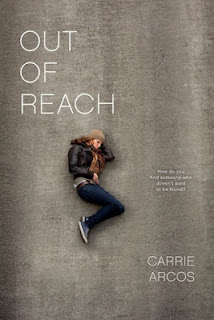
Out of Reach by Carrie Arcos

Goodreads' description:

"How do you find someone who doesn’t want to be found? A girl searches for her missing addict brother while confronting her own secrets in this darkly lyrical novel.Rachel has always idolized her older brother Micah. He struggles with addiction, but she tells herself that he’s in control. And she almost believes it. Until the night that Micah doesn’t come home.

Rachel’s terrified—and she can’t help but feel responsible. She should have listened when Micah tried to confide in her. And she only feels more guilt when she receives an anonymous note telling her that Micah is nearby and in danger.

With nothing more to go on than hope and a slim lead, Rachel and Micah’s best friend, Tyler, begin the search. Along the way, Rachel will be forced to confront her own dark secrets, her growing attraction to Tyler…and the possibility that Micah may never come home.
" 

Addiction has always been an area of interest for me, and that plus the mystery of this anonymous note Rachel receives gives this one a promising premise. I like the simple design of the cover, conveying nicely the dark tone of the story.

Trinkets by Kirsten Smith


"Sixteen-year-old Moe's Shoplifters Anonymous meetings are usually punctuated by the snores of an old man and the whining of the world's unhappiest housewife. Until the day that Tabitha Foster and Elodie walk in. Tabitha Foster pretty much has everything she wants: money, friends, popularity, a hot boyfriend who worships her...and clearly also a yen for stealing. So does Elodie, who, despite her goodie-two-shoes attitude pretty much has "klepto" written across her forehead in indelible marker. But both of them are nothing compared to Moe.

Tabitha, Elodie, and Moe: a beauty queen, a professional wallflower, and a burnout-- a more unlikely trio high school has rarely seen. And yet, when Tabitha challenges them to a steal-off, they set off down a road of strange friendship linked by the thrill of stealing and the reasons that spawn it."


This one looks a good deal lighter than Out of Reach, but I'm hoping that there'll be some exploration of the psychology surrounding kleptomania. Shoplifting pops up fairly often in YA novels, but is usually treated quite casually, and is not on a clinical sort of level. I'm interested to see how Kirsten Smith tackles the motivations and behaviour of teens who can't stop stealing.

What books are you waiting for?


Related Posts with Thumbnails