
I have never been a fan of books with talking animals.
I don't mean animals that use onomatopoeia to communicate, I mean honest-to-goodness apparently-speaking-in-English animals. Lots of kids' books seem to have very gregarious four-legged creatures and I know children often love them, but I was not one of those children.
Small Review posted recently about some things that turn her off certain books, and one of them was talking animals. My comment turned into a little rant and so I thought I'd do a whole discussion post about it here. I'm trying to figure out why exactly I dislike some talking animal stories and not others (because there are exceptions, certainly), and I also wanted to get everyone else's opinions about it.
I think it boils down to a few key questions:
A) Who do these animals talk to?
Namely, is it:
1) Only to each other? For instance, in Watership Down, Redwall, Babe, The Cricket in Times Square, and Silverwing, the animals are the protagonists, and if humans are involved, they're not on speaking terms with them. For the most part I think I wasn't big on these books because I couldn't connect with the main characters, since they were all animals.
 |
| Plus Watership Down was just plain creepy. |
 |
| The beavers from Narnia are multi-talented. Not only do they talk, they even cook dinner! |
B) Is this story set...
1.) In the real world? For example, Charlotte's Web is set on an ordinary farm, The Wind in the Willows near a river in the British countryside, James and the Giant Peach starts out at a cottage in England by the sea, and Doctor Dolittle travels all over the world. Somehow it always seemed to me very contradictory to have all the limitations of our actual world cast aside when it came to animals' linguistic abilities.
 | |||
| Wilbur: "I can talk! I can actually, factually, talk!" Me: Please don't. |
 |
| Even the White Witch doesn't approve of talking animals. Especially not talking lions. |
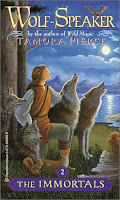 C) Is the animal-talking due to magic of some kind?
In The Goose Girl the main character Isi is able to mind-speak with her horse. And Tamora Pierce's heroine Daine, from the Immortals series, also has an ability to mentally communicate with animals. I find the whole thing much easier to swallow if it is presented this way, probably because I'm not trying to picture animals moving their jaws and physically producing the English language.
D) Are these animals really humans who just shapeshift?
Because if they're werewolves or were-tigers or were-elephants or whatever, then for the most part I think of them as human. And it seems the general rule for writing shapeshifters is to have them communicate mentally anyway.
 |
| Yep, Jacob Black looks human enough to me... :D |
 |
| Don't worry about talking animals...worry about talking DRAGONS. |
So, what about you guys? Love talking animals in books? Hate them? Like them only when they talk to each other? Tolerate them, but barely? Let me know!


