Showing posts with label PTSD. Show all posts

July 5, 2013

Insurgent: A Close-Up Review


"One choice can transform you, or destroy you. Every choice has consequences, and as unrest surges in the factions all around her, Tris Prior must continue trying to save those she loves, and herself, while grappling with haunting questions of grief and forgiveness, identity and loyalty, politics and love." (from Goodreads)


 Insurgent by Veronica Roth

*Note: There will be spoilers here for events that occurred in the first book, Divergent, so you have been warned! If you'd like to read it, here's my review of Divergent.

Characters:

Tris: she undergoes a lot more introspection and personal analysis in this second book in the series. She's a little more vulnerable than in Divergent, as she hasn't gotten over shooting Will and it's given her major post-traumatic stress disorder.

Tris really develops the "Abnegation" part of herself here and even though she's quite ruthless at times, she'll put herself out for people she cares about if they're in danger. She also shows her "Erudite" side more as well. We actually get to see Tris using her intellectual capabilities more — thinking more logically and strategizing — and I appreciated that the power of intellect is displayed this way, showing that these abilities can be used in positive ways as well. Although, it's kind of difficult to say "positive" or "negative" about anything in this book, really — things are not as black and white as Candor would have them be. Still, Tris tries to do what's "right" most of the time.

Tobias: I didn't like his character that much in this one. He seems to have pretty high standards for Tris, and then gets disappointed easily when she doesn't come through for him. He needs to stop building up all these expectations about her, because he makes mistakes and he has to expect that she'll make some too. He definitely had a point about her being reckless, but I feel like he didn't appreciate Tris' selfless side enough. He seemed to get almost hardened towards the end, very "Dauntless", and wasn't allowing himself to be open-minded to different possibilities. Instead, he had a very narrow focus and seemed blind to the pitfalls of the path he was going down.

Tris & Tobias: their relationship is very tense and tumultuous in this one. They both make a lot of mistakes and need to grow up — which I think Tris accomplishes more than Tobias. He still has to work on trusting Tris, and become more aware of his own biases (spoiler, highlight to read: in particular, how blinded he was by prejudice towards his father).

Because they're both keeping things from each other, unfortunately a lot of their intimate scenes just didn't feel authentic. Plus, neither of them was very happy in this book, so they couldn't be happy together; usually when one was feeling content, the other was worrying about something. Basically, they were not in a very good spot for most of Insurgent. That said, I think they needed to get it out of their systems, and I suspect the third book will show a united front from them. That's usually how it goes in a trilogy, especially a YA dystopian one (just to break it down quickly: in book 1 the characters fall in love, in book 2 there's conflict in the relationship, and in book 3 they unite once again to fight a common enemy). I have the feeling that's the way this one's going to go. But I'm glad there wasn't a love triangle — I think that would have been pointless and contrived. Rather, the problem here was all about their own misunderstandings and mistrust, and not sharing everything they should have with each other was their downfall in this book. I'm hoping that they learn from that and aren't hiding stuff from each other all the time in book 3.

World-building:

As in the first book, the serum mind-control thing still bugged me. I think it's one of the weakest aspects of the world-building; people wandering around like zombies just seems a little far-fetched. I'd also like more explanation of the science behind being Divergent, as well as the science behind the assessment test and simulation serums. Insurgent goes into the neurophysiology of Divergence a little in discussing Tris's brain scans, which I found quite interesting, and I thought the psychology behind that was fairly accurate and made sense (spoilers: Divergent individuals have more mirror neurons, leading to greater empathy; a small reward-seeking center; and a larger than average prefrontal lateral cortex). The author must have taken the time to look up parts of the brain and figure out how they might be different in a Divergent. What I don't get, though, is how these people developed — why some are Divergent and others aren't. It seems to be treated like flipping a switch, either you're Divergent or you're not, but you can't be just slightly Divergent...which doesn't seem very realistic.

Plot:

Insurgent is darker than Divergent, with more emotional gravitas. It deals with PTSD, plenty of dangerous situations, people dying left, right and center, war criminals, psychological torture...it's intense. Insurgent shows how entrenched a memory can be, and how traumatic stress can linger and affect someone in the present. It's made clear that PTSD isn't something you can just "snap out of", and on the whole I thought the illustration of PTSD was very well done.

There were a lot of twists I didn't see coming (major spoilers: her brother betraying her! Also, Peter being the one to save her — which I thought was fitting.) I thought the climactic scene could have been improved upon in some ways; it was shorter than I expected and featured a rather predictable obstacle. Spoilers: Tris has to kill "herself" in order to get to the door, which is an idea that's been done before. I liked that there was an intellectual activity that needed to be completed before you could breach security, but I wish there were more! I thought it was going to be like the first Harry Potter book, with all of these tricky traps you have to think through.

I wish Amity had been involved more. Quite frankly, I agree with the other bloggers who've said that the cover is misleading. It's not a huge mental leap to assume that because the first book had fire on the cover and focused on the Dauntless faction, that a cover with a tree as the symbol would focus on Amity. But there is more fighting than peace that goes on in here, and really I ended up feeling a little cheated that we didn't get to see more of Amity! If anything I think a more accurate cover would have alluded to Candor, since a lot of this book revolves around truth. I'm hoping that Amity plays a bigger role in the next book, as I feel like we've still only scraped the surface of their faction. It feels like they get somewhat dismissed by Tris, as though she thinks they're a bunch of useless cowards. I'd like to see Roth showing a stronger, more positive side to them.

Spoilers for the ending: I kinda liked the whole idea that this was an experiment. It's like a much better version of The Maze Runner, in that the reason they developed this society was originally to try again and make humanity better. Obviously that hasn't exactly worked out, but I think this revelation will lead really well into a totally different third book, where we learn about what's outside the gates!

The end left me feeling a little unsettled; I think I wanted more resolution to the Tobias/Tris feud than I got, or perhaps the way it was resolved just felt too easy and cliched. Spoilers: I wanted more of an apology from Tobias at the end, or for Tris not to forgive him so easily for turning his back on her. His quick reversal from not believing her to believing her came off as somewhat predictable and contrived. 

I also had some difficulty visualizing the places mentioned and remembering who was who (there are a lot of deaths in here!), and I found it challenging to keep track of the timeline of events.

Final verdict: 4.5 shooting stars. This, like Divergent, is an captivating whirlwind of a read, but it has broadened in scale from the first book, becoming more epic. I didn't like a lot of the choices the characters made, but I appreciated that Tris really grew in this book.


Note: there is some mature content (namely violence) in this book.

September 28, 2012

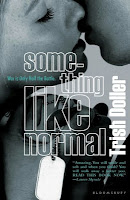
Something Like Normal: A Psychtember Review

Patient: Something Like Normal by Trish Doller

Presentation (from Goodreads): "When Travis returns home from a stint in Afghanistan, his parents are splitting up, his brother’s stolen his girlfriend and his car, and he’s haunted by nightmares of his best friend’s death. It’s not until Travis runs into Harper, a girl he’s had a rocky relationship with since middle school, that life actually starts looking up. And as he and Harper see more of each other, he begins to pick his way through the minefield of family problems and post-traumatic stress to the possibility of a life that might resemble normal again. Travis’s dry sense of humor, and incredible sense of honor, make him an irresistible and eminently lovable hero."
Assessment:

Axis 1. Characters

The characterization in Something Like Normal is wonderful. Travis has one of the most authentic and yet still appealing guy voices I've read in quite a while — and this is coming from someone who doesn't typically like 1st-person teen guy POVs. It's difficult for me to find books with a male teen narrator where I'm interested in what they're saying and can connect to them on some level, and I feel like Trish Doller really accomplished that with Travis. He's a flawed character, to be sure; his behaviour's less than ethical at times, he shows spurts of temper, and though he recognizes he has some psychological issues, he's not quite ready yet to take the step of admitting he needs help. And yet despite these flaws, there's something very attractive about him. I like his honesty, and the way he doesn't take flack from people. 


I feel like he wants to be a better person, and he realizes that he's a better person when he's around Harper, so he wants to be with her. It's neat that we get to be inside Travis' head and see him starting to fall for Harper and care about someone in a way he hasn't before. As for Harper, I appreciated that she stood up for herself and didn't let him walk over her. I think they're good for each other — Travis is pretty bitter and jaded at the beginning, and as Harper softens him up he starts to become more hopeful. She seems like a steady girl who will keep him grounded. Paige provides a nice foil for Harper, since Travis feels very differently about each of them.


Travis' dad is a very generic, "All American" sports dude. He doesn't ever really venture out of cliche, but he's obviously intended to be disliked — and he certainly succeeds at serving that purpose. Basically, he's one of those really irritating dads who want to live vicariously through their kid, and want to see their kid do well so they can be hotshots. He reminded me a lot of the jock's dad in The Breakfast Club, who's pressuring his son all the time. In short, he's a jerk.

In contrast, Travis' mom actually cares about her son, and it's really sweet to see that. I like that he's standing up for his mom, and that they're getting to know each other better after so many years of her sitting on the sidelines while his dad railed at him. 

It's clear that Travis had a strong connection with Charlie (a fellow Marine and friend who was killed) and that their friendship was very important to him. We don't see that kind of emotional bond very often with male characters (at least, not in YA), so it was refreshing to see that level of connection here.


Axis 2. Premise/plot


There isn't much action happening here, but it's quite short and surprisingly readable — I breezed through it in just a couple of days. It could have been a little more dramatic in places (for instance, the PTSD could have been amped up) and I wish a few of the storylines had been more fleshed out. I never felt like we had a good grip on Travis' relationship with his brother Ryan, so I would have liked to have seen more of that (Ryan just seems to get dropped out of the story after a certain scene). More information about the political side of things in Afghanistan would also have been interesting, although obviously that isn't the point of this book. Rather, it's all about Travis' recovery and his emotional healing process, and that is done really well.

In terms of the ending, things wrapped up awfully fast, with a lot being resolved within just the last few chapters, and I think it could have been stretched out a bit more. It seemed too neat and easy a conclusion, with a couple of "heart-to-heart" conversations that dipped into cheesy/sappy. The closing letter was a nice touch, though. While the ending is hopeful, it left me feeling sad in some ways, too. Overall, it's a kind of bittersweet book, not entirely uplifting — Charlie's dead at the beginning and so obviously he's still dead at the end. I was glad that Travis winds up in a better place emotionally, though.

Axis 3. Writing Style

Trish Doller's ear for the male teen voice is impressive. A lot of female authors writing YA novels with male perspectives don't succeed at this aspect, but the way Travis talks and thinks seems quite "guy-like". Most of the dialogue is authentic, and Doller does not shy away from coarse language/references and distasteful jokes in some situations (for example, when Travis is hanging out with his Marine pals). While crude conversation isn't something I really enjoy, I can appreciate that it feels real.
 
Axis 4. Psychological Accuracy

Travis' main psychological problem is quite obvious: post-traumatic stress disorder (PTSD). He displays some of the classic symptoms, such as nightmares/difficulty sleeping, startling easily (gunshots set him off), flashbacks, and a dislike of talking about his time spent in Afghanistan. These symptoms fit quite neatly with the DSM-IV criteria


In addition to these, he exhibits signs of psychosis in the form of hallucinations — usually of Charlie. Apparently it's not unusual to experience psychotic symptoms along with PTSD, so this is also in line with research on trauma. 

It's interesting that we're shown a little of how another soldier has reacted differently. Kevlar turns to alcohol and thrill-seeking; he wants an adrenaline rush all the time, the kind that he got in Afghanistan and doesn't get anymore. Adrenaline seems to act similarly to an addictive substance for some individuals. I suspect these are also signs of PTSD — indeed, the upcoming DSM-V has added "reckless or self-destructive behavior" to the list. 

I would have liked to have seen the stigma of mental health issues, especially in the military, discussed a little more. It's touched on slightly (in particular, Travis states, "The evaluation is also supposed to gauge our mental wellness, but that's a joke. We say everything is okay because the fastest way to wreck your career is to admit it's not.") but not addressed in detail. I also wish we'd gotten a glimpse of Travis' therapy, but it's just mentioned at the very end in passing.
 
Validity Score: How psychologically accurate was Something Like Normal?


Axis 5. Miscellaneous

I liked that it's not too preachy, and that the author isn't taking a strong political stand here. As I mentioned earlier, politics don't play a big role, but when they do surface they aren't handled in a black-and-white kind of way. 

A couple of the blurbs on the back of the book use the word "unflinching," which makes it sound like it could be gritty and violent. It's emotionally tough and depressing, definitely, and feels like this is something that someone who's come back from Afghanistan would experience, but there's nothing really graphic in here at all. In fact, I think the "grit" factor could even have been raised a bit more (although I wouldn't want it to degenerate into gratuitous violence).
 
Patient shares symptoms with: BADD by Tim Tharp, The Things a Brother Knows by Dana Reinhardt, Purple Heart by Patricia McCormick


Patient's statement:


I lift my beer cup for a drink. Dirt fills the lines of my hand, and my fingers are stained with blood. The cup slips from my grasp, splashing beer across the top of the table. Paige jumps off Ryan's lap, shrieking something at me, but I don't understand what she's saying. My chest is tight and I'm having trouble breathing.


I have to get out of here.
 
Diagnosis: 4 shooting stars. This is definitely a good book to check out if you're interested in PTSD or soldiers' reactions to war, or if you're looking for a distinctive and sympathetic male teen narrator. It doesn't bring anything really novel to the subjects of war and trauma, but it excels in characterization and relationships.


This book counts towards my goals for the Debut Author challenge, the Just Contemporary challenge and the New Adult reading challenge.


Note: This book contains some coarse language/references and sexual content. 

Also, I interviewed Trish Doller earlier this month

For more information about PTSD, see here.

September 22, 2012

Guest Post: Prescription Drug Abuse (and Streamline E-Book Giveaway!)

I'm pleased to welcome Jennifer Lane, author of the YA novel Streamline, to the blog for a Psychtember guest post!

First, a bit about the book:

"Seems like Leo Scott has it all: looks, brains, and athletic talent. He's captain of his high school swim team with a bright future in college and beyond. But Leo has secrets. His mother's crippling car accident has devastated his family and left Leo to deal with his father's abuse, battered and alone.

Leo's girlfriend Audrey Rose is poised for her own share of success. As one of Florida's top high school swimmers, Audrey dreams of college swimming stardom. But there's an obstacle to her glorious rise to the top. Her number-one supporter-her father-is in prison for murder.

Part murder mystery, part tale of young love in a military family, this gripping story takes readers on a journey from Pensacola to Annapolis. Leo and Audrey must band together to rise above the adversity they encounter and find their true selves in the process. When everything's on the line . . . streamline.
" (from Goodreads)

Thank you to Danya for inviting me to the Psychology YA Event!

As a psychologist/author (psycho author), I’m fascinated by mental health issues, especially in the Young Adult/New Adult age group. My high school and college psychotherapy clients are really fun to work with because there’s so much opportunity for growth during this time of life. They also teach me how to be hipper and more technologically advanced!

Today I’ll highlight the issue of prescription drug abuse in teens, which is a growing problem. According to the National Institute of Drug Abuse, every DAY 2,000 teens abuse prescription drugs. Taking these medications without a doctor’s prescription can be dangerous, sometimes even more so than illegal drugs. “Abuse can include taking a friend's or relative's prescription to get high, to treat pain, or because you think it will help with studying.” (http://teens.drugabuse.gov/facts/facts_rx1.php)

I feature oxycodone addiction in my YA sports romance Streamline. Leo Scott is a 17 year-old swimmer who faces his naval commander father’s impossible demands. When Leo inevitably falls short, his father beats him. At first Leo tries his mother’s Oxycontin pills to help recover from physical pain. But then he gets hooked on the drug’s numbing effects on his emotional pain. He’s less aware of his low self-worth and high anxiety when he steals his mother’s medication.

If you’ve ever taken prescribed pain medication and disliked the effects as much as I have, you might wonder how an individual could become addicted. But only a minority of users is most susceptible to getting hooked. I heard one doctor estimate that only 10% of individuals enjoy the feeling provided by pain medication. Some risk factors for addiction are:

* Family history of addiction (alcoholism, drug abuse). There’s evidence we can inherit brain pathways that light up with euphoria from alcohol or other drugs. Most people can control their use because their brains have a more moderate response.

* History of Post Traumatic Stress Disorder. Recent research shows that individuals with PTSD experience more physical pain and may use substances to numb out from flashbacks. There is a high correlation between sexual abuse and addictive behaviors.

* Poor coping skills. Negative feelings are a part of life. Buddhism’s first Noble Truth states “Life is difficult and painful by nature, not because we’re doing it wrong.” When we learn how to cope with heartache effectively (e.g. talk to friends, ask for help, write in a journal, exercise, pray, be mindful, engage in self-care) we don’t need to numb out from negative feelings. But many of us don’t know how to deal with the crap life throws our way. And those who have other risk factors might succumb to drug addiction.

Streamline follows Leo’s journey. His initial euphoria and numbing fade over time, until he’s not using the drug to feel good, but instead to get back to baseline. Feeling compelled, he takes the drug despite all of the negative consequences it causes. Leo learns that Oxycontin affects the brain like heroin, and his withdrawal is awful—like the worst flu of his life.

Can Leo discover his strengths and learn to like himself better? Can he develop more effective skills for coping with negative emotion? Like anyone addicted to pain medication, he has a tough road ahead of him.

"People fascinate the psychologist/author (psycho author) known as Jennifer Lane. Her therapy clients talk to her all day long about their dreams and secrets, and her characters tell her their stories at night. Jen delights in peeling away the layers to scrutinize their psyches and emotions. But please rest assured, dear reader, she isn’t psychoanalyzing you right now. She’s already got too many voices in her head!

Stories of redemption interest Jen the most, especially the healing power of love and empathy. She is the author of The Conduct Series—-romantic suspense for adult readers—-and is currently at work on the third and final installment: On Best Behavior. Streamline is her first foray into writing for young adults, but she’s found this sort of writing even more fun. A former college swimmer, Jen was able to put a lot of her own experiences into this book."

Thanks very much, Jennifer, for this informative post on prescription drug abuse in teens and your book Streamline!

Jennifer has generously offered up an e-book copy of Streamline for giveaway:

The rules:

- Entrants must be 13 years or older.
- Open internationally
- One entry per person
- Following and tweeting are not necessary but always appreciated!
- Ends Sept 30, at 11:59 pm EST.
- Winner will be selected randomly and contacted by e-mail

To enter, please fill out THIS FORM. Comments are fabulous but do NOT count as entries.

September 21, 2012

Speak: Guest Review

I'm pleased to welcome Najela from Brave New Adventure back to the blog today for her guest review of Speak by Laurie Halse Anderson. Najela contributed a series of guest posts for Psychtember last year, on the Big 5 personality traits in YA characters (Openness, Conscientiousness, Extraversion, Agreeableness, and Neuroticism), and this is the first of several guest reviews she's doing this year!

Summary:  Melinda Sordino is an outcast because she called the police and broke up a wild party. She had her reasons for calling the police, but she must keep them a secret. As a result of the incident that occurred at the party, Melinda is silent and doesn’t speak. She is failing school, ditching class, her parents are fighting and inattentive, and her friends have deserted her. Melinda only has her art class to look forward to and her assignment is to spend the year with artistic works centered around the word given to her by her teacher. Melinda’s word is “tree”. When the past comes to haunt her, will Melinda be able to speak up for herself and protect her friends?

Likes: Even though Melinda doesn’t speak much, her inner thoughts are amazing to read. I  laughed at the way she perceives the world. I cried when she recounts the incident at the party. The author has made Melinda an intelligent and witty character who doesn’t wallow in her sorrow, even though it would be justifiable if she did. She doesn’t have any friends, people push her and bump into her at the halls. Melinda doesn’t dwell on these problems nor does she mope around the entire book. She takes action and she tries to heal as well. Taking action is how she heals. When she comes to the terms with the incident, we watch her journey from being a pushover for her new “friend” Heather to finally standing up for herself and saving countless others by speaking up.

Psychological Aspect: I believe the psychological aspect is done well. Selective mutism and PTSD (post traumatic stress disorder) is what I believe that Melinda is struggling with and it written in a way that is empathetic without invoking pity. I think it’s important to realize that every character deals with situations in different ways and that there is no right or wrong way to grieve and heal. Anderson allows Melinda to grieve and heal without telling her (or readers) what they are supposed to feel. .

Writing Tip:
When writing a character who can’t/won’t speak, it is important to make their inner voice engaging and interesting.

Another book to read:
The Mockingbirds by Daisy Whitney


Najela is a graduate from UC Riverside with a dual degree in Psychology and Creative Writing and finally making the most of both degrees. She works with kids and is currently pursuing a Master's Degree in Exceptional Student Education. She is also working on several writing projects including a Beauty and the Beast retelling webcomic coming in late October 2012. You can follow her at her website or her tumblr.

Thanks very much for sharing your thoughts on Speak, Najela!

September 20, 2012

Psychtember Interview with Trish Doller (and Giveaway!))

I'm excited to have Trish Doller on the blog today for an interview about her debut YA novel Something Like Normal!

First, a bit about Trish and the book:

"I've been a writer as long as I've been able to write, but I didn't make a conscious decision to "be" a writer until fairly recently. For that you should probably be thankful.

I was born in Germany, grew up in Ohio, went to college at Ohio State University, got married to someone really great, bounced from Maine to Michigan and back to Ohio for awhile. Now I live in Florida with my two mostly grown kids, two dogs, and a pirate. For real.

I've worked as a morning radio personality, a newspaper reporter, and spent all my summers in college working at an amusement park. There I gained valuable life skills, including counting money really fast, directing traffic, jumping off a moving train, and making cheese-on-a-stick. Also, I can still welcome you to Frontier Town. Ask me sometime.

These days I work as a bookseller at a Very Big Bookstore. And I write." (from her website)

"When Travis returns home from a stint in Afghanistan, his parents are splitting up, his brother’s stolen his girlfriend and his car, and he’s haunted by nightmares of his best friend’s death. It’s not until Travis runs into Harper, a girl he’s had a rocky relationship with since middle school, that life actually starts looking up. And as he and Harper see more of each other, he begins to pick his way through the minefield of family problems and post-traumatic stress to the possibility of a life that might resemble normal again. Travis’s dry sense of humor, and incredible sense of honor, make him an irresistible and eminently lovable hero." (from Goodreads)

And now for the questions...

1.) In addition to some traditional symptoms of post-traumatic stress disorder, Travis also experiences a more unusual symptom — hallucinations. Psychosis is not currently one of the diagnostic criteria for PTSD (according to the DSM-IV), but has certainly been known to occur in conjunction with it. Why did you choose to give Travis this symptom? In particular, how do you feel Travis' hallucinations of Charlie affect the reader's understanding of his character and behaviour?

When I first imagined SOMETHING LIKE NORMAL, I planned for Travis to be physically wounded. He was missing a leg. But the logistics of getting him from point A to point B in every scene became overwhelming, and I started brainstorming ways to manage this. Then I read the memoir of a Marine's experience with PTSD (Soft Spots: A Marine's Memoir of Combat and Post Traumatic Stress Disorder by Clint Van Winkle) and I realized that not all wounds are physical. I think Travis' hallucinations--my cues for which came from Clint's personal experiences--bring the reader a better understanding of what Charlie meant to Travis and how his guilt keeps Charlie alive.

2.) Harper's presence obviously helps to calm Travis down and relieve his anxiety on more than one occasion. How important do you think social support is for individuals struggling with PTSD? What benefits would you say it provides that medication or therapy do not? Are there any ways you feel friends or family might unintentionally hinder an individual's recovery?

I think the underlying message I've received from people suffering from PTSD is that it's part of their lives but not their whole lives. They may need medication and therapy, but the social support goes a long way in helping them feel "normal." There is a scene in SOMETHING LIKE NORMAL in which Travis spends a day fishing with his friends and enjoying time with Harper, and he feels the closest to good that he's felt in a long time. While I'm not an expert, it seems logical that spending time with supportive friends and engaging in positive activities would work well in concert with medication and therapy. And again, while I'm not widely studied on PTSD, I would venture that trying to force an individual suffering from PTSD to talk about before he or she is ready would be unhelpful, even if well-meant.

3.) Travis and Kevlar both exhibit difficulty in re-adapting to life in the US, but they demonstrate this in different ways. Do you think one of them has healthier coping mechanisms? In the long-term, who do you think will be more successful in overcoming their psychological distress?  

I worry that Kevlar's problem avoidance and adrenalin addiction could be a collision course for disaster. I haven't really attempted to look into his future, but reading stories about soldiers with similar coping mechanisms seem to end with the individual developing more problems or ending in death. While I'd like to think that Travis is on the better road to recovery, I left him very deliberately at the end of SOMETHING LIKE NORMAL. He's acknowledged his problems and sought help, but what happens when he returns to Afghanistan? As an infantry Marine, it's unlikely he'd continue treatment while in-country, so we can only hope that the support group he's developed (his mom, Harper, Charlie's mother) and his therapy journal, will be a strong enough foundation to carry him through. That said, I think he's more likely to succeed than Kevlar.

4.) The stigma of mental illness in the Marines is briefly touched on in Something Like Normal. How large a factor would you say this attitude played in Travis' reluctance to seek professional help? In what ways would you suggest the system be changed to better accommodate veterans dealing with mental health issues?


I asked a former Marine what advice he would give to an active duty Marine who recognizes he has a problem, but fears seeking mental health treatment within the organization and his advice was to do it privately through a non-military professional and pay out of pocket. Stay off the radar. While he was speaking from his own experience, I'd be willing to bet it's a pretty clear window on the stigma of seeking help within the system. I'm not sure the answer, but I've read a lot of stories about going to the VA and coming out with pills. And while I think medication can be helpful, I think getting individual (or even group) therapy helps. I know some Marine vets get together to have beers and talk, and I feel like talking is the key. Primarily with people who understand or have been there.

5.) Your next YA novel, All That Was Lost, involves a girl whose mother has bipolar disorder. Can you give us a sneak peek of what we can look forward to?

In ALL THAT WAS LOST, Callie's mother suffers from borderline personality disorder, but--like the PTSD in SOMETHING LKE NORMAL--I approach the subject with a light hand. Callie is dealing with many issues when her story begins and her mother is just one of them. While her life is not unaffected by her mother's illness, the story is primarily about family and the meaning of home. Here's a short snippet from the beginning of the story, when Callie is still with her mother and does not yet fully understand that her mother even suffers from a disorder:

I wonder what set her off this time. It could have been something the man in the leather jacket said. It’s as if she hears things at a different frequency, the way a dog picks up sounds the rest of us miss. Or maybe she hears something that isn’t really there at all. Either way, when she’s ready to go, there is no arguing. There is only leaving.

Thanks very much for these thoughtful answers to my questions, Trish! I'll be keeping an eye out for All That Was Lost come 2013 :)

Trish has generously offered up a copy of Something Like Normal for a giveaway!

The rules:

- Entrants must be 13 years or older.
- Open internationally
- One entry per person
- Following and tweeting are not necessary but always appreciated!
- Ends Sept 30, at 11:59 pm EST.
- Winner will be selected randomly and contacted by e-mail

To enter, please fill in THIS FORM. Comments are awesome but do not count as entries.

September 10, 2012

Guest Post: Where Real Meets Unreal

I'm happy to welcome Dr. Sarah Fine, author of the upcoming YA novel Sanctum, back to the blog for another Psychtember guest post! (You can read Sarah's guest post from last year here.)


Where Real Meets Unreal: Characters’ Reactions to Trauma in YA Speculative Fiction

When I was in the early stages of writing SANCTUM (which comes out only a few weeks from now! October 16th! Yipes!), I made a decision: The protagonist, Lela, had to be a tough, scrappy fighter, someone who could believably sneak her way into hell and battle whatever she came up against. Out of that decision blossomed Lela’s past, which is marked by abuse and loss. But … as a psychologist who’s worked with kids who’ve been through some pretty tough stuff, I couldn’t give Lela that kind of history without consequences for her as a character. It left her wounded. Vulnerable. In need of some healing even though she couldn’t yet ask for it.

Basically, I created a character who exhibits many symptoms of post-traumatic stress disorder (PTSD), though in the contemporary urban fantasy world of SANCTUM, it is never called exactly that. But if we consider the formal diagnostic criteria in the DSM-IV, Lela’s experience definitely meets Criterion A (a trauma which involved a threat to her “physical integrity” and her own helpless reaction to it), Criterion B (re-experiencing of the trauma; I’m trying not to spoil things so I won’t get specific), Criterion C (at least three symptoms of avoidance/numbing of responsiveness), and Criterion D (at least two symptoms of hyperarousal, things like exaggerated startle response and hypervigilance to threats) for PTSD. The trauma occurs two years prior to the start of the story, and the symptoms have dogged her ever since. How they impact her actions and relationships—and how she evolves as a result of what she goes through in the dark city beyond the Suicide Gates—is a significant part of her development as a character throughout the series.

In fantasy, there’s often not a lot of room for formal diagnostic talk or labels, which is something you see more often in contemporary YAs like Wintergirls, Hold Still, Willow, and Life Is But A Dream. A few contemps, such as Compulsion, are specifically about a mental illness but don’t necessarily label it. A notable exception is Jackie Morse Kessler’s fascinating fantasy series about the Riders of the Apocalypse, in which several of the characters have diagnosable disorders, including anorexia and self-harm (which is a nonspecific symptom of several different disorders, actually).

But usually, in speculative fiction, we don’t see this so much. Considering the occurrence of mental illness in adolescents (1 in 5!), you might think we would, but the sci-fi/fantasy genres tend to have a different focus. The big exception here, however, is reactions to trauma. Which makes sense, because the characters regularly go through terrifying, life-threatening things. In fact, I might argue that we don’t see truly impairing reactions to traumatic events in YA sci-fi/fantasy/dystopians as often as you might expect, given what authors (including myself …) put their characters through. I mean, there aren’t a ton of studies on how frequently PTSD occurs after a traumatic event, but in a study of folks in Manhattan after 9/11, it turned out well over 50% had at least one identifiable symptom of PTSD in the 5-8 weeks afterward. In other words, it’s pretty common to experience some lingering effects after something that scary.

The Marbury Lens is all about what could be considered an acute stress reaction (ASR) but is not at all a clinical examination of it (because it’s A LOT more complex and wild than that). And in Insurgent, Tris exhibits several clearly identifiable symptoms of Acute Stress Disorder, the only thing she could really be diagnosed with so shortly after a trauma (PTSD can only be diagnosed a minimum of one month after the trauma). She has some re-experiencing of the event, avoidance of things that remind her of it, and symptoms of increased emotional arousal. HOWEVER … she doesn’t exhibit any dissociative symptoms (that I could detect), so she doesn’t actually meet formal criteria for the disorder. That doesn’t mean she isn’t deeply affected by what happens at the end of Divergent, though.

In Catching Fire and Mockingjay, Katniss experiences debilitating symptoms of PTSD (so do a few of the other characters). In reading those books, I really felt like Suzanne Collins captured how persistent and crippling those symptoms could be. I appreciated how, in books that portray incredible brutality and violence, she did not shrink from showing the severe and lasting effects of those things on the characters. It wasn’t like they got out unscathed—quite the contrary. They (most of them, at least) were not destroyed by their experiences, but they were changed by them, and not in a good, healthy way. Despite that, they persisted, and in my opinion, there’s true heroism and bravery in that alone.

What are some other fantasy or sci-fi books you’ve read that cover the characters’ reactions to traumatic events? Are there any that strike you as being particularly well done? Have you read books where you wonder how the character manages to endure intense trauma and come away seemingly unscathed? Where do you think this type of thing—true PTSD or any other mental disorder—fits within the scope, plots, etc. of non-realistic/contemporary YA fiction?

Sarah Fine got her doctorate in clinical psychology and specializes in working with children and their families. Her YA urban fantasy debut, SANCTUM, will be published on October 16th (Marshall Cavendish Children's Books/Amazon Children's Publishing). She is represented by Kathleen Ortiz at New Leaf Literary. Her blog, The Strangest Situation, is about the (messy, awesome, blurred, thrilling) intersection of those two endeavors.

Thanks so much, Sarah, for this insightful analysis of trauma portrayals in YA fantasy and sci-fi! Readers, what are your thoughts on this topic? How would you respond to the questions Sarah raises?

July 31, 2012

Article 5: A Panoramic Review

"New York, Los Angeles, and Washington, D.C., have been abandoned.

The Bill of Rights has been revoked, and replaced with the Moral Statutes.

There are no more police—instead, there are soldiers. There are no more fines for bad behavior—instead, there are arrests, trials, and maybe worse. People who get arrested usually don't come back.

Seventeen-year-old Ember Miller is old enough to remember that things weren't always this way. Living with her rebellious single mother, it's hard for her to forget that people weren't always arrested for reading the wrong books or staying out after dark. It's hard to forget that life in the United States used to be different.

Ember has perfected the art of keeping a low profile. She knows how to get the things she needs, like food stamps and hand-me-down clothes, and how to pass the random home inspections by the military. Her life is as close to peaceful as circumstances allow.

That is, until her mother is arrested for noncompliance with Article 5 of the Moral Statutes. And one of the arresting officers is none other than Chase Jennings—the only boy Ember has ever loved.
" (from Goodreads) 
Article 5 by Kristen Simmons
 
My reaction: 


This is one of those books that you can enjoy as long as you don't think about it too much. If you critically analyze the world-building, things will begin to fall apart. It's both quite conventional for a dystopian novel — think militarized regime à la 1984 — and not that plausible. I was skeptical that the military and people high in command would actually care about a couple of runaways like Chase and Ember; I just don't see it as being a practical, efficient use of resources (along with the reform schools). Basically, Chase and Ember are living in a police state and always on the run. That's pretty much all you need to know, and trying to figure out how everything fits together — the past war, the Statutes, the evacuations, the weird reform schools for girls — will not lead to success.

Plot-wise, it's predictable. The one big revelation that happens towards the end I had my suspicions about for a while (spoiler, highlight to read: I suspected that the mom was either dead or going to die). I guessed the plan for how Ember was going to extract Chase and herself from a tough spot before she executed it. So don't go into this expecting a whole bunch of surprises that you can't see coming. Also, I wasn't totally sold on the climactic scene; I think things were a little too easy for Ember and Chase, and the adversary they faced should have been able to do something else.

That said, as a reading experience I found Article 5 to be pretty gripping, and I was really into it most of the time. There was a point at which I was feeling the whole thing was pointless and had lost its direction; Ember and Chase go from one skirmish or hiding place to another without accomplishing anything for quite a while. But then the big revelation occurs and that changes things.

Best aspect: the post-traumatic stress disorder (PTSD) aspect of Chase's character. (PTSD has always been an area of psychology that's interested me.) His behaviour is never officially labelled, but it's clear that's what Chase is dealing with. He's obviously torn about his involvement in the military — he's a strong fighter, but he feels sick about what he's been forced to do. This guilt mixes with blame of Ember for not asking him to stay (though this is pretty irrational, since what could they have done, really? He was drafted...if he disobeyed, they would have been on the run anyway, right?). Of course, Ember blames him, too, since he's present when she and her mother are arrested. 

Their relationship is fraught with tension. In one way, it's a slow-burn romance (you're going to have to wait a while for any kisses!), but since they have a history and were involved before, it's not a new romance. There are all these memories and past stuff that they either need to talk about or get over. Ember's memories of Chase from before work really well to contrast with the current Chase — they're almost different individuals in her mind.

If I could change something... I'd make Ember a little more self-reliant and independent right from the start. To be honest, Ember bugged me in parts. She spends a lot of her time doing the following: panicking, freaking out, crying, and being scared (sometimes all at once!). Since Chase is from the army and knows more than Ember about the society and survival, and he and Ember spend most of the book together, she relies on him heavily. As in: there will be a danger, Chase will come to the rescue and save Ember, she will cling to him, and then they will bond before they remember all their issues and go all cold and distant with each other again. This happens multiple times with different dangerous situations: lather, rinse, repeat. Aspects of their relationship — his protectiveness of Ember, his greater strength, his tendency to save her all the time — might remind you of the Bella-Edward relationship in Twilight, so you have been warned.

However, to put things in perspective, I feel like many of us would do the same as Ember in the situations she faces. I think I would be freaking out too if someone was pointing a gun at me or I was hiding while someone else was getting murdered nearby. If there was a strong guy like Chase next to me, I might very well be clinging to him in shock too...so I don't think I can blame Ember all that much. But the Ember-crying-at-the-drop-of-a-hat thing does get tiresome. Thankfully, Ember also has some good qualities; she's extremely loyal to her mother, and cares about integrity and ethics — not only her own, but also Chase's. And she goes through some important character development and comes into her own at the end, a key piece of information eventually pushing her into a place of greater mental strength. Hopefully she won't regress to her previous behaviour in the next book.

If you haven't read it: and you liked the quick pace and constant danger of The Hunger Games and the slow-burn, "forbidden" romances in Matched and Birthmarked, you'll probably enjoy Article 5. But if you're a reader who wants to think critically about the dystopian elements of the society, you'll likely be dissatisfied.

If you have read it: do you agree with the above comparisons? How do you think this book stands up to those others?

Just one more thing I want to mention: at times I was reminded
of Nazi Germany and the Holocaust. The desperate lengths people will go to when threatened or starving are portrayed well here.

Quote: 


"My terror grew, closing off the world around me. Chase's presence didn't soothe me as it had in the past. The mouth that had once curved into a smile and softened against my lips was a hard, grim line. There was no warmth in him now. This was not the Chase I remembered. This wasn't my Chase."


Final verdict: 4 shooting stars. I know I've touched on a lot of weaknesses above — shaky world-building, clichés and stereotypes, repetitive plot. But despite all of that, it was a good reading experience for me, and for the most part I enjoyed the romance and the characters. If you can tune out the many questions or criticisms that may arise as you read it, and just go along for the ride, you might find yourself surprisingly riveted to its pages.

 
Disclaimer: I received this for review from the publisher.


Note: Article 5 contains some mature content (scenes of violence).

This book counts towards my goal for the Debut Author reading challenge.

October 6, 2011

The Unbecoming of Mara Dyer: Guest Review

Bonnie from A Backwards Story is dropping by today with a guest review of The Unbecoming of Mara Dyer for Psychtember!

The YA psychological thriller of the year is, without a doubt, THE UNBECOMING OF MARA DYER. I was reading my ARC of this amazing debut novel back when Danya announced Psychtember. Immediately, I knew this book would be a perfect fit. Mara Dyer suffers from PTSD. If you’re unfamiliar with the term or what it entails, Wikipedia defines PTSD as:

  Posttraumatic stress disorder (also known as post-traumatic stress disorder or PTSD) is a severe anxiety disorder that can develop after exposure to any event that results in psychological trauma. This event may involve the threat of death to oneself or to someone else, or to one's own or someone else's physical, sexual, or psychological integrity, overwhelming the individual's ability to cope. As an effect of psychological trauma, PTSD is less frequent and more enduring than the more commonly seen acute stress response. 

Diagnostic symptoms for PTSD include re-experiencing the original trauma(s) through flashbacks or nightmares, avoidance of stimuli associated with the trauma, and increased arousal – such as difficulty falling or staying asleep, anger, and hypervigilance. Formal diagnostic criteria (both DSM-IV-TR and ICD-10) require that the symptoms last more than one month and cause significant impairment in social, occupational, or other important areas of functioning. ~quote taken from PTSD’s Wikipedia page

Mara used to be an ordinary, happy teenager…until the day she woke up in a hospital to discover that her world had been shattered. One night, she snuck into an abandoned mental asylum with her best friend, boyfriend, and boyfriend’s sister…and the building collapsed. Mara was the only survivor, with barely a scratch on her—but she has no memory of that night.

She’s so traumatized by what happens that she cries in her closet, and has nightmares and visual hallucinations. She does things she doesn’t remember such as wind up with a bloody shard of mirror in her hand. Her mother is concerned and takes Mara to see a specialist, where she is diagnosed with PTSD.

The family moves to Florida hoping for a fresh start so that Mara can heal and move on, but the PTSD never goes away. Instead, it gets worse, but she tucks her hallucinations away where no one can find them and pretends that she’s coping. For example, Mara will be walking down the hallway to her room and see a portrait of her grandmother. She’ll believe that her grandmother’s eyes are moving, that she’s watching Mara. One day, she’s watching a news report concerning the murder of local student Jordana Palmer, but seeing a report where the police have recovered her friends’ bodies from the asylum.

When Mara walks into class for first time at new school and sees the classroom fall apart the way the building she’d been trapped in did and falls and bloodies up her nose. (Way to make a first impression, right?)

“Cracks appeared in the classroom walls as twenty-something heads turned in my direction. The fissures spidered up, higher and higher, until the ceiling began to crumble. My throat went dry. No one said a word, even though dust filled the room, even though I thought I would choke. 

Because it wasn’t happening to anyone else. Just to me. A light crashed to the floor right in front of the teacher, sending a shower of sparks in my direction. Not real. But I tried to avoid them anyway, and fell.” (~pg. 29, US hard cover edition, first printing)

When she goes into the bathroom to wash up, she hallucinates and sees a sinister image of one of the dead girls. That same day during lunch, she hears a dead boy’s laugh behind her, but of course, no one is there…until she turns the corner and swears she sees him:

“Someone laughed behind me. My head snapped up as my blood froze. It was Jude’s laugh. Jude’s voice. I stood slowly and faced the fence, the jungle, as I hooked my fingers in the metal and searched for the source. 

Nothing but trees. Of course. Because Jude was dead. Like Claire. And Rachel. Which meant that I’d had three hallucinations in less than three hours. Which wasn’t good.” (~pg. 35, US hard cover edition, first printing)

There’s another early incident where Mara sees a dog that has been abused by its owner and, fueled by hate, daydreams about his death. The man dies in the exact way she imagined during school hours. Or was he dead when she got there and she imagined their entire confrontation, which is why she so vividly imagined his death later?

The hallucinations get more serious. Mara becomes paranoid, thinking she’s being watched, thinking someone’s breaking into her house. Mara winds up seriously injured, making her mother think she’s suicidal. She experiences scenarios that may or may not be occurring in reality.

“But when I pulled into the driveway, her car wasn’t there. Neither was my father’s. The lights inside the house were off too. Where were they? I went to the front door and reached out to unlock it. 

The door swung in. Before I touched it. 

I stood there, my fingers mere inches from the handle. I stared, my heart in my throat, and raised my eyes slowly up the length of the door. Nothing unusual. Maybe they just forgot to lock it. 

…But the second I entered the hallway, I froze. When I had left the house with Daniel, all of the family pictures had been hung on the left side of the wall, opposite three sets of French doors on the right. 

But now all of the pictures were on the right. And the French doors were on the left. The yogurt fell from my hands, spattering the wall. The spoon clattered to the floor and the sound snapped me back into reality. I had a bad night. I was imagining things. I backed out of the hall, then ran to the kitchen and snatched a dishtowel from the oven handle. When I went back to the hallway, everything would be where it should be. 

I went back to the hallway. Everything was where it should be. 

I hurried to my bedroom, closed the door behind me, and sank onto my bed. I was upset. I shouldn’t have gone out; the party was not, in fact, what I needed. The whole thing was nervous-making and stressful and was probably causing a PTSD episode. I needed to relax. 

…I went to the closet to slip off my dress, but then I froze. An opened box sat on the closet floor. I had no memory of taking it down from the shelves. No memory of ripping the tape off the flaps and opening it since we’d moved. Did I leave it out? I must have. 

…When I noticed the silence, it stole the air from my lungs. I backed away from the closet and peered into the bathroom. The faucet was off. A single drop of water fell, sounding like a bomb in the stillness. The bathtub had overflowed, making the ceramic tile reflect the light like glass. 

I didn’t remember turning the water off. 

But I must have. 

But there was still no way I was getting in. 

…The bathtub drain needed to be unplugged. I made my way over to it carefully, but everything inside me screamed bad idea. I leaned over the edge. 

The emerald and diamond earrings glinted at the bottom. I raised my hands to my ears. Yup, gone. 

…I tested the water with my finger. Nothing happened. 

Of course nothing happened. It was only a bathtub. The pictures had distracted me and I let I overflow, then turned it off without remembering it. Everything was fine. I plunged my arm in. 

….For a second, I could not think. It was as if all feeling beneath my elbow had been cut off. Like the rest of my arm never even existed. 

[hospital]…‘Your arm must have been there for some time,’ [the doctor] said, meeting my eyes. ‘These are some serious burns.’ 

What could I say? That I tested the water before reaching in and it didn’t seem that hot? That it felt like something grabbed me and held me under? I could see in the doctor’s eyes that he thought I was crazy—that I did it on purpose. 

[later at home]...‘I was going to take a bath, but the earrings—’ I took a shaky breath. The earrings you lent me fell into the tub. I had to get them before I could unplug the drain.’ 

‘Did you?’ my mother asked. 

I shook my head. ‘No.’ My voice cracked. 

My mother’s eyebrows knit together. She walked over to me and put her hand on my earlobe. I felt her finger unhook the back of an earring. She held the emerald and diamond stud in her flat palm. I lifted my hand to my other ear; that one was in, too. I removed the earring and placed it in her hand as tears welled in my eyes. I’d imagined the whole thing. ” (~Excerpts from a scene between pgs. 144-151, US hard cover edition, first printing)

I’m not a psychologist, so I couldn’t personally say whether or not Hodkin is realistically portraying PTSD. To me, it feels well. Throughout the novel, it’s unclear whether or not Mara is losing her mind. What’s real and what isn’t? I’ll leave it for the experts to weigh in on the psychological ramifications of Mara’s experience!

For me, I just enjoyed the story for what it is. Which events are truth, and which are lies? Mara’s life is spinning out of control. Is she crazy? Is something unexplainable happening? Is there more at stake than what meets the eye? Unfortunately, answers won’t be provided until the sequel drops in 2012.

Bonnie runs the book review blog A Backwards Story.  While she isn't a psychologist, she is a writer and likes looking at the psyche of a character and seeing what makes him/her tick.  THE WRITER'S GUIDE TO CHARACTER TRAITS by psychologist Dr. Linda Edelstein is her favorite book to recommend to other writers because it's an in-depth look at every type of person, from serial killers to toddlers to one's boss.

Thanks so much for giving us a look at the depiction of PTSD in The Unbecoming of Mara Dyer, Bonnie!  

Bonnie has a more general (not psychology-focused) review of the book up on her blog here (which includes a detailed cover design vlog!)

Related Posts with Thumbnails